Are N Scale Pocket Modules the Future of Model Railroading?

For generations, the dream of the model railroader has been the same: build a layout big enough to capture the feel of a real railroad. But there is one problem—space.

Basements are getting smaller, garages are being reclaimed, spare bedrooms have other uses, and many modelers simply don’t want a permanent layout dominating their home.

That may be where an interesting idea begins to emerge: the N Scale Pocket Module.

Small Enough to Fit Almost Anywhere

T-TRAK has already demonstrated that N scale can be broken down into small, portable building blocks. Standard T-TRAK modules are approximately one foot long and designed to sit on ordinary tables, making them easy to store, transport and combine into much larger layouts.

But what if we took the concept even further?

Imagine a module designed around a small, highly detailed scene—perhaps only a few inches deep and roughly the size of a large book or shadow box. Instead of trying to build an entire railroad, the modeler builds one memorable scene at a time.

A small depot.

A rural grade crossing.

A feed mill.

A section of downtown.

A bridge over a dry Southwestern arroyo.

A locomotive servicing facility.

Each becomes its own little railroad world.

The “Pocket” Philosophy

The attraction isn’t simply that pocket modules are small.

It’s that they could change how we build model railroads.

Instead of saying:

“I need a room for my railroad.”

The modeler can say:

“I have room for a railroad scene.”

That is a significant difference.

A pocket module could sit on a bookshelf, desk, coffee table or display cabinet. When operating day arrives, several modules could be brought together and connected to create a larger railroad.

And when operating is finished?

Put them back on the shelf.

Why N Scale Makes This Possible

N scale is particularly well suited to this concept because its smaller size allows meaningful railroad scenes to be created in very little space.

T-TRAK has already proven that modular N scale can grow from a few small sections into surprisingly large layouts. NTRAK describes T-TRAK as a system of standardized building blocks that can be combined into increasingly complex arrangements.

Pocket modules could take that philosophy in another direction.

Instead of building more railroad, the emphasis becomes building better scenes.

That could appeal to modelers who enjoy scenery, structures, weathering and detailing as much as they enjoy running trains.

A Different Kind of Model Railroad

One of the most interesting possibilities is that pocket modules could become collectible.

Imagine a modeler having twenty small scenes stored on a bookshelf.

One weekend might feature a 1950s Santa Fe branch line.

The next could be a Southwestern mining scene.

Another might recreate an industrial district.

Another could depict a small-town depot.

The railroad changes every time the modules are rearranged.

And because each scene is relatively small, the modeler can potentially spend considerably more time detailing it.

Instead of spending years trying to finish a giant layout, you can actually finish something.

That is a powerful idea.

Perfect for Clubs and Shows

Pocket modules could also have tremendous potential for model railroad clubs.

A new member could build one module without committing to an enormous project. Experienced modelers could build highly detailed specialty scenes. Members could bring their modules to a club meeting and combine them with others.

The result could be a railroad that is different every time it is assembled.

That is already part of the appeal of T-TRAK: individual modules can serve as standalone scenes while also becoming components of a larger layout. (Ntrak)

Pocket modules could simply push that concept toward smaller, more personal scenes.

The Future May Not Be Bigger

For decades, the model railroad hobby often seemed to celebrate size.

Bigger layouts.

More track.

More trains.

More industries.

More scenery.

But perhaps the future isn’t necessarily bigger.

Perhaps it is smarter, smaller and more flexible.

The future model railroad might not occupy an entire basement. It might occupy a bookshelf.

It might be built one scene at a time.

It might be transported in a small case.

And it might be assembled differently every time the trains come out.

So, Are Pocket Modules the Future?

It’s too early to say.

But the concept fits several realities facing today’s model railroaders: limited space, portability, the desire for detailed scenery, and the growing popularity of modular layouts.

T-TRAK has already shown that small standardized modules can make model railroading accessible to people who don’t have room for a traditional permanent layout.

The next step could be making those modules even smaller, more detailed and more personal.

Maybe the future of N scale isn’t a 4-by-8-foot layout.

Maybe it isn’t even a basement empire.

Maybe it’s a collection of little railroads sitting on a shelf—waiting to be connected.

Small enough to fit in your pocket.Big enough to capture the imagination.

And that might just be the future of N scale model railroading.

Are N Scale Pocket Modules the Future of Model Railroading? Read More »

T-TRAK on a Budget: Build It Yourself and Save

One of the biggest advantages of T-TRAK model railroading is that you don’t have to spend a fortune on the basic module. With a little time and some simple woodworking, 5 mm plywood can produce a lightweight, strong T-TRAK module for a fraction of the cost of a commercial kit.

For the Southern New Mexico N Scalers, we’re looking at using the standard T-TRAK widths for single, double, and triple modules, while using a 14-inch depth to provide more room for scenery and structures.

What Does the Plywood Cost?

Home Depot currently lists a 3/16-inch, 2’ × 4’ plywood project panel—the closest readily available size to 5 mm—for about $11.54 per sheet.

A 2’ × 4’ panel provides 8 square feet of material. Enough for 1 triple module!

With an efficient cutting plan, that inexpensive sheet can provide most or all of the plywood needed for a T-TRAK module.

Approximate Material Cost

Module: Single Double Triple

Width: 12-1/8” 24-1/4” 36-3/8”

Depth: 14” 14”. 14”

Approx.

Plywood

Cost*: $6-$12 $12-18 $12-$24

*Estimated plywood consumption depends on the module height, internal bracing, and cutting layout. Actual cost can be reduced further when multiple modules are cut together to minimize waste.

Add a few dollars for wood glue, brads or screws, and miscellaneous hardware, and a reasonable target for the basic scratch-built structure is roughly $10–$25 for a single and $20–$30 for a double or triple, depending on material efficiency.

Compare That With Buying a Kit

Commercial kits offer convenience, precision-cut parts, and instructions—but you’re paying for those services.

For example, current N-scale commercial T-TRAK single-module kits are selling for approximately $28–$30 before track and scenery.

That means a scratch-built module can potentially save $15 or more per module.

Build ten modules and the savings can easily reach $150 or more.

For a club building a large layout, that adds up quickly.

Where Should the Savings Go?

That’s the real advantage of scratch-building.

Instead of spending another $15–$20 on the box, that money can go toward the things people actually see:

  • Kato Unitrack
  • Ballast
  • Structures
  • Vehicles
  • Trees and vegetation
  • Figures
  • Lighting
  • Signs
  • Scenery materials

In other words:

Build the benchwork. Buy the details.

More Than Just Saving Money

Scratch-building also gives us something a commercial kit can’t always provide: complete control over the design.

A 14-inch-deep module gives us substantially more scenic space than a traditional shallow module. We can build Southwestern scenes featuring desert washes, industries, highways, depots, ranches, mines, and small communities.

And because the module widths remain standardized, individual modules can still come together to form a much larger railroad.

The Bottom Line

Commercial T-TRAK kits are a great option for someone who wants convenience.

But if you’re willing to spend an afternoon cutting and gluing plywood, scratch-building can put considerably more railroad on the table for your dollar.

At roughly $11.54 for a 2’ × 4’ sheet of 3/16-inch plywood, the basic structure is inexpensive.

For a Southern New Mexico N Scalers club project, that makes scratch-built 5 mm plywood modules an attractive way to get more members involved, keep costs down, and put the savings into the part of the hobby we all enjoy most:

Building the railroad.

T-TRAK on a Budget: Build It Yourself and Save Read More »

Rails, Smiles and Community: Southern New Mexico N Scalers Bring T-Trak to Life at Mesilla Valley Mall

LAS CRUCES, N.M. – JULY 25, 2026

The sound of miniature locomotives rolling down the rails, the excitement of children watching trains make their way through a miniature world and plenty of smiles filled the Mesilla Valley Mall on Saturday as the Southern New Mexico N Scalers hosted their T-Trak Run Day. 

For railroad enthusiasts, families, curious shoppers and everyone who simply enjoys seeing something a little different, the event offered a wonderful glimpse into the world of N-scale model railroading and demonstrated that model trains are about much more than trains. 

They are about people, creativity, imagination and togetherness. 

What is T-TRAK?

T-TRAK is a modular model railraod system designed around individual sections, or modules, that can be connected together to create a much larger layout. 

Unlike traditional permanent model railroad, a T-TRAK layout can be assembled, rearranged, expanded and transported. Each modeler can build and decorate their own module while following standardized track and wiring specifications. When the module comes together, individual scenes become part of one interconnecting miniature railroad. 

This modular approcah is what makes T-TRAK so special

One person’s module might feature a small-town business. Another might represent a farm, a railroad industry, or even Noah’s Ark.Put them together and suddenly those individual creations become a living railroad community. 

It’s much like the real railroad itself: different places, different people, different stories but all connected by the rails.  

Perhaps the most memorable part of the July 25 Run Day wasn’t any one particular locomotive, module or scenic detail. It was the reaction of the people who stopped to watch. Their smiles when the train came around the bend. The questions of how the tiny structures were built. The childhood memories of their first train set.

There were people who simply stopped simply because they were walking from one side of the mall to the other an something caught their eye. 

For a few moments, the busy mall became a place where people slowed down, looked, talked and shared experiences with one another.

If the smiles and wonder seen at the Mesilla valley Mall that day are any indication of the future of model railroading, teh Southern New Mexico N Scalers are traveling down a very promising track. 

The trains may be small – but the friendships, creativity and community they create are anything but.

T-TRAK Togetherness

Rails, Smiles and Community: Southern New Mexico N Scalers Bring T-Trak to Life at Mesilla Valley Mall Read More »

Clovis Area Train Society Upside Down Christmas Virtual Train Show


Video 1 of the Clovis Area Train Society’s Upside Down Christmas Virtual Train Show. Video one features a 128 car Covered Hopper unit train.

Video 2 of the Clovis Area Train Society’s Upside Down Christmas Virtual Train Show. Video 2 features several Passenger Trains.

Video 3 of the Clovis Area Train Society’s Upside Down Christmas Virtual Train Show. Video 3 features several freight trains.

Video 4 of the Clovis Area Train Society’s Upside Down Christmas Virtual Train Show. In Video 4, the CATS attempt to run a 120+ caboose train. Enjoy!


Clovis Area Train Society Upside Down Christmas Virtual Train Show Read More »

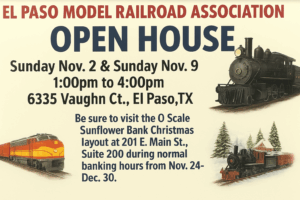
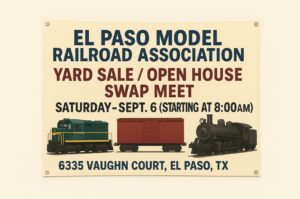
El Paso Model Railroad Association Yard Sale, Open House, and Swap Meet


We’ll be selling an exciting selection of classic model trains, locomotives, freight and passenger cars, cabooses, buildings, landscaping materials, track, and more!
Come see our operating Model Railroad Layouts in multiple scales.

Click the link below for event details.

El Paso Model Railroad Association Open House, Yard Sale, and Swap Meet

El Paso Model Railroad Association Yard Sale, Open House, and Swap Meet Read More »